Empty space, drag to resize
I’m off to Kelowna next week for a one-day Cognitive Functional Therapy (CFT) immersion with Prof Peter O’Sullivan to kick off the
Orthopaedic Symposium. I wanted to beam myself over to the Canadian Pain Society
conference the same day but—spoiler alert—I still haven’t mastered quantum cloning. Maybe a future AI side-kick will sort that out. Until then, here’s a CFT-flavoured Friday Five you can actually read in one universe at a time.
Just in time, a new secondary analysis—
Hancock et al., 2024—dropped, and it’s basically rocket fuel for CFT. This Friday Five is a lightning-round tour of that study and how we can roll the findings straight into clinic life.

The bigger the struggle, the bigger the bounce.
The
RESTORE trial (492 chronic LBP patients) sliced its data by
baseline disability (RMDQ). Folks sitting around a 7 on the RMDQ (mild limitation) still got a respectable 3-point edge over usual care. But crank that baseline score up to 18 (can’t tie shoes, dread the grocery run) and CFT handed them a 6-point jump at 13 weeks—and a 7-point lead a year later.
That’s well above the “worth the hassle” threshold for patients.
It basically tells us:- Stop assuming severe = stuck. These are the people who bloom.
- Show this stat to patients on day 1. Nothing kills learned helplessness faster than data saying, “You’re exactly who this works for.”
Fast-track CFT for the highly disabled.- RMDQ ≥ 13: Skip the waitlist—book a dedicated CFT block.
- RMDQ 7–12: CFT still delivers, but a “compact” format (core pain education + graded movement coaching) works if time is tight.
- RMDQ < 7: Standard physio with a light CFT overlay is usually enough.
Automate the sort: most EMRs can auto-score online RMDQs and some can ping you when a score crosses 13—instant triage with zero extra admin.
Why it matters: Hancock et al. (2024) showed patients at the severe end (RMDQ ≈ 18) gained 6–7 points more than usual care, while mild cases still improved but by a smaller margin. Aim your limited CFT resources where they make the biggest dent.

What’s your favourite trick for cracking stiff thinking (cognitive flexibility)?
High cognitive flexibility sped up early gains in the study.
Do you use mirror work? Story swapping? “What if…” movement games?
Print Figure 2 below and slap it on the staff-room fridge.
It’s a glorious reminder that the steeper the hill, the more CFT boosts the climb.
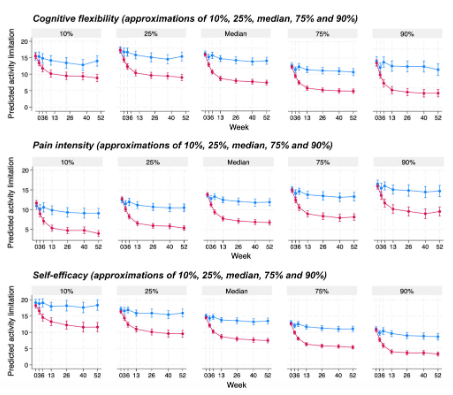
What are you looking at? Across all baseline levels of cognitive flexibility, pain intensity, and self-efficacy (columns = 10th to 90th percentiles), the red lines (CFT) show consistently larger and more durable drops in activity limitation than the blue lines (usual care).
In other words, CFT outperforms usual care regardless of where a patient starts on these factors, with the biggest separation appearing early and holding through 52 weeks.

Complex patients need complex thinking, but simple doing.
CFT isn’t magic because of circus-grade exercises; it’s the rinse-and-repeat loop:
- Make sense – co-create a pain story that actually fits their experience.
- Expose with control – nudge into feared moves while dialling down threat.
- Lifestyle coaching – sleep, stress, movement snacks, repeat. Do what's salient.
The heavy lift is in our reasoning; the home program should be so doable they can finish it during the Netflix intro. Keep the brainy stuff in the clinic and the homework dead simple, and watch those RMDQ numbers drop.
Empty space, drag to resize
Many people with persistent pain struggle with sleep—but let’s be real, most don’t have access to ongoing support for it. And in physio sessions, we’re often so focused on movement and pain that there’s just not enough time to dive deep into sleep habits.
So… voilà. When resources are tight, innovation gets a push.
I’ve built a
4-Week Sleep Reset—a free email series packed with simple, science-backed habits, behavioural nudges, and practical support for better sleep. It’s designed for people who need help but don’t have time or access to full-on coaching.
Also, nope, it’s not a Huberman protocol. 😄
Share it with anyone who might need it—friends, family, patients.
Stay nerdy,