

Jan 30 • Sean Overin

Pain Trajectories, CFT Insights & Clinical Lessons from Peter O’Sullivan

Empty space, drag to resize
Awhile ago, I had the absolute privilege of attending a full-day workshop with Peter O’Sullivan, one of the minds behind Cognitive Functional Therapy (CFT). I went in thinking my clinical approach was pretty aligned... turns out, I’ve still got some growing to do. 

The good news? I’m energized and will make changes in how I show up for people in pain.

Also—Peter’s team just launched evoolvepaincare.academy, a stellar new hub for training and resources. Bookmark it.
Chen et al., Pain (2018): A 5-year back pain crystal ball. 

Unfortunately, the narrative that “it’ll just get better” doesn’t hold up.

This study followed people for 5 years and found 4 clear pain trajectories—plus some early flags for who’s likely to struggle:

Empty space, drag to resize

🔍 The 4 Pain Paths

  • No or Occasional Pain – These folks bounce back fast. 🙌
  • Persistent Mild Pain – Some nagging, but manageable.
  • Fluctuating Pain – Up, down, up again—like a yo-yo 🎢
  • Persistent Severe Pain – The tough one. Pain sticks around. 😣

Spoiler: 25% landed in the persistent severe group—but that’s the crew we’re most worried about.
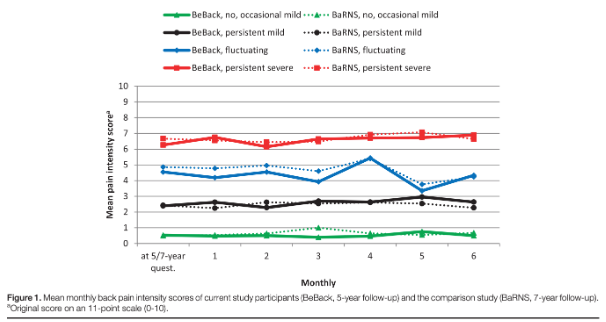
This figure shows the four long-term pain trajectories identified in the Chen et al. (2018) study, comparing two different cohorts: BeBack (5-year follow-up) and BaRNS (7-year follow-up).Each line represents mean monthly back pain intensity scores over time (0–10 scale):
  • Green (No or Occasional Mild Pain): Very low pain throughout—consistently around 0–1.
  • Black (Persistent Mild Pain): Steady low-level pain (~2–3), showing little fluctuation.
  • Blue (Fluctuating Pain): Pain levels bounce around (4–5), with noticeable month-to-month shifts.
  • Red (Persistent Severe Pain): Consistently high pain (~6–7) across the entire follow-up period. 

🧠 Key insight: These patterns are remarkably stable over years—reinforcing the idea that early identification of trajectory (and intervening accordingly) could change someone’s long-term experience of back pain.

Empty space, drag to resize

🚨 Who’s at Risk for a Rough Ride?
Some signs scream “this could get sticky”—and they show up early. 

🔬 Early life adversity & genetics – Set the stage for a sensitive system
😰 Chronic stress – Keeps the volume knob turned up
🧠 Mental health conditions – Depression, anxiety, trauma = higher risk
🔥 Higher baseline pain – The fire’s already burning
😟 Unhelpful beliefs – “I’ll never get better,” “My back is damaged”
🛋️ Passive coping – Resting, guarding, avoiding
📉 Lower socioeconomic status – Social disadvantage makes everything harder 

👉 Spot these early, and we’ve got a better shot at changing the story. 

🧠 Translation: People weren’t doomed by their back—they were thrown off course by fear, beliefs, and life stress. This really aligns with what patients expect from their therapist — a plan that addresses biology and psychology.
🧠 So What Do We Do With This? 

If sensitive nervous systems, beliefs, fear, avoidance, etc are what fuel chronicity, then our job isn't just to hand out exercises—it's to help people make sense of what’s happening and feel safe enough to move again. 

Cognitive Functional Therapy (CFT) nails this.

It’s not just about movement patterns—it’s about meeting the person where they’re at: 
✅ Listen for distress
✅ Spot protective behaviours
✅ Normalize their experience
✅ Build confidence through movement 

When we help people feel safe, understood, and in control, the trajectory can change.
Even for the “tough” cases.
Empty space, drag to resize

💥 Clinical Mic Drop

This paper hammers home what most of us already feel in our gut: 

If we don't help people shift gears early, pain sticks around.
 
🧰 So ask early: 
  • What do they believe is going on?
  • How are they responding to the pain?
  • Are they starting to shut life down?
  • Has this problem got them down? 


And get them to start wondering: 
  • What would life look like without this pain? 


💡 And guide them back to movement, back to life, and back to confidence.
Since the workshop, I’ve been watching for the “invisible stuff”: 
  • Holding breath during movement
  • Pre-bracing or co-contraction without realizing it
  • Slow, cautious movement patterns
  • Avoiding certain motions even in casual conversation 


Are you seeing or looking for this stuff? 


🔥 My new default: 

“Can we try that again, but without holding your breath?”

The change is almost immediate when safety is felt rather than told.
Empty space, drag to resize

📄 1. Rajasekaran et al. (2021)
MRI language matters.
Scary-sounding MRI reports make patients more fearful.
Add a calm, reassuring tone? Fear goes down.
👉 How we talk about imaging changes how people feel about their bodies.

Empty space, drag to resize

📄 2. Steffens et al. (2015)
So what actually triggers back pain?
Awkward posture, heavy lifting, being tired, and distracted = higher risk.
Especially in the morning.
👉 It’s not just the load—it’s the context.

Empty space, drag to resize

📄 3. Saraceni et al. (2020)
Is flexing your spine while lifting bad?
Nope. No link between flexed lifting and low back pain.
👉 Avoiding flexion isn’t evidence-based—it’s fear-based.
“Don’t chase the pain—chase the behaviour.”

People avoid flexion, load, or movement not because they’re broken—but because they feel fragile, fearful and uncertain. And we’ve (sometimes unintentionally) reinforced that. This often where patients learn their beliefs, from well-intentioned healthcare professionals. 

Here’s what I want to bring more of into my practice: 
🧘 “Relax and move—don’t brace.”
👁️ “Be the observer, not the responder.”
💨 “Breathe into it.”
🎯 “It’s safe. Your safe."
🕹️ “You’re in control.” 

Each cue is a nudge toward confidence, calm, and agency—retraining the nervous system through experience, not just explanation.

Stay nerdy, 

Sean Overin, PT