
Apr 14 • Sean Overin

What nobody tells you about running a health practice until you are already in it

You spent years becoming a great clinician. Then you opened a practice and
discovered that running a business is a completely different skill set. Here's what can help.
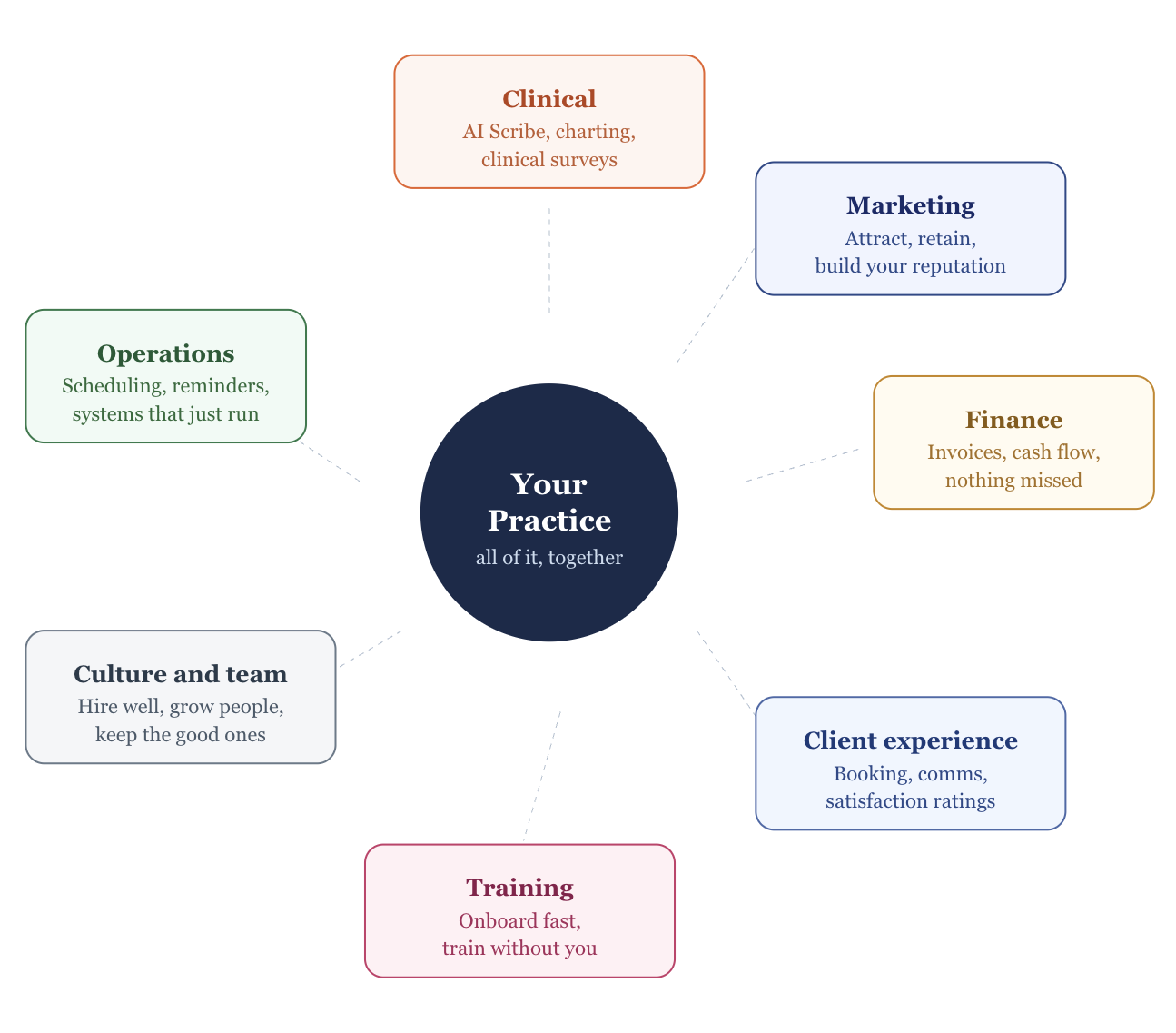
When I was getting started, I had a solid clinical foundation, good people skills, and an outstanding business partner. I was also ready to embrace a lot of uncertainty and completely naive idea of how much admin was coming my way. Spoiler: it was a lot. Booking, intake, charting, billing, following up on unpaid invoices, reminding patients about appointments they will definitely forget. None of that was in the curriculum. 

It is a common thread you hear from practitioners online and in conversation. The clinical training is excellent and thorough. The business training is basically a pamphlet or in my case, a 1 hour lecture at the end of a 7 hour neuroanatomy session and a wish of good luck. A lot of people figure it out as they go, experience is a great teacher, but it is a harder road than it needs to be.

Knowing what I know now, getting the right software in place early is one of the highest-leverage decisions you can make. This frees you to focus on actually treating people, supporting your team, your culture, the marketing, partnerships and all the other things, instead of chasing down paperwork and getting bogged down by tasks.

We use Jane. Here is some of what it can do.

If you want a deeper look on how others use Jane to support their private practice, check out how to start a private practice

Empty space, drag to resize

Experts do the basics well

For those unfamiliar, Jane is an EMR and practice management platform built specifically for health and wellness practitioners. It handles the day-to-day operational layer of a clinic: booking, intake, documentation, billing, and getting paid. The key word there is specifically. Jane was not built for dentists and then awkwardly adapted for physios or other rehab providers.

It was designed for this context, which means the workflows actually fit and make sense.

  • Online booking so patients can schedule without waiting for you to answer the phone
  • A secure patient portal for intake forms and communication
  • AI Scribe for faster, less painful documentation
  • Jane Payments so billing isn't an awkward conversation after each appointment
  • Workflows that fit how you want to practice

That last one matters more than it sounds. A lot of software assumes you work a certain way and makes your life harder when you do not. Jane is flexible enough to adapt to your setup rather than the other way around.

Empty space, drag to resize

It does some marketing homework too

Most practitioners do not think of their EMR as a marketing tool. That is fair, because most EMRs are not. Jane is a bit different.

Automated appointment reminders go out without you touching anything. Fewer patients who completely forgot they had a session at 9am on a Wednesday. Scheduling automations handle the back-and-forth that would otherwise eat your front desk time or, if you are running solo, your own time and sanity.

Beyond the automations, Jane gives you actual numbers on how your practice is performing. How many new patients are you seeing? What does your retention rate look like? Are patients satisfied with the care they are getting? Jane's ratings feature pulls that data together so you have something concrete to look at instead of just hoping things are going well.

You can also pull data to see where your referrals are coming from. Is it word of mouth, healthcare providers, Google or somewhere else. You can get this information, track it on a monthly basis, and start making strategic decisions on what tactics are working and which ones are not for your practice.

New Patients

Track volume over time

Retention Rate

See what percentage of patient's are returning

Jane Ratings

An window into patient satisfaction

Referrals

Where are they coming from?
When you are making decisions about hiring, marketing, or even just whether the practice is moving in the right direction, that data is genuinely useful. Most small practice owners are flying blind because they have no clean way to track it. You do not have to be one of them. What you can measure you can manage. 

Empty space, drag to resize
Billing clarity that will save your sanity

Let me paint a picture. It is end of month. You are pretty sure a few patients or insurers still have outstanding balances, but you cannot remember which ones, and tracking it down involves digging through emails and invoices in three different places. Fun, right. 

Jane makes this genuinely simple. You can see at a glance what has been invoiced, what has been paid, and what needs following up on. Everything is in one place. It is far less likely that something slips through. For a growing practice, that kind of billing clarity is not a nice-to-have, it is the thing that keeps revenue where it belongs. 

Onboarding new staff without losing your mind

At some point, if things go well, you will hire someone. That is exciting and also a little terrifying, because now you have to get them up to speed on everything including the software.

Jane has a pretty solid library of training videos that cover the platform clearly and practically. New staff can work through them independently, which means you are not spending every afternoon over a 3-4 week period, giving a one-on-one walkthrough of how to book an appointment. They get the training, you get your afternoon back. You're creating a win-win.

Having a platform your staff can actually learn without you needing to their every step of the way is one of those things that sounds minor until you are hiring your third person in a year and realize how much time and energy it saves.


The support team is the part people do not expect

When I was starting out, I did not have all the answers (not even close). Nobody does, and anyone who tells you otherwise might have a very selective memory. What helped was having a support team that was fast, genuinely knowledgeable, and wanted to help.

You have probably heard this before, but Jane's support team is available six days a week by chat, email, or phone. They know the platform well and they understand the context of running a health practice. In practice, that means you get to the solution faster instead of spending twenty minutes explaining your situation before someone actually helps.

What I also respect is that Jane is open to feedback and acts on it. The platform has evolved over time in ways that reflect real input from practitioners. That is not something every software company does. It means you are not just a customer, you are part of how the product improves.

The Bottom Line

Running a practice is harder than it looks from the outside, but of course, it can be done. The clinical side is the part you trained for. The operational side is the part that can consume you if you do not set it up properly from the start.

Jane handles a lot of that operational layer well. Booking, documentation, billing, reminders, data, training, support. It is not magic, but it is a well-built platform backed by a team that clearly cares. For a new or growing practice, that combination goes a long way.

If you are in the early stages of building something, or you are tired of your current setup and looking for a change, it is worth a look.

If you are ready to go, use my code for a one-month grace period on your new account. If you want to a book demo, you won't be disappointed. Check them out, learn about the good stuff they bring to any clinical practice, and elevate your business game. 

Thanks for reading,

Sean

Sean Overin, PT