Empty space, drag to resize
I came across a case this week that has stuck with me a bit. I have seen many, many cases just like it in the past. I am sure I will continue seeing others.
This case is not rare or complex. Bread and butter physio stuff.
I meet a patient six months after a total knee replacement, still in significant pain. Now this isn’t uncommon and unfortunately, upwards of 20–30% of people report ongoing pain at one year (
ref).
That said, walking was still very difficult. She was frustrated, questioning the surgery, and starting to lose confidence in her decision.
And underneath it all, there was a pattern of care that did not create the optimal conditions for healing.
Empty space, drag to resize
Tall Tree Health Cordova Bay: September 18 and 19, 2026
Constipation, bloating, and bowel dysfunction. The gut–brain–pelvic axis. Learn to treat this well.
Hybrid Course Design:
- 6 hours pre-course videos + articles
- 2 day In Person Workshop: Lecture, Lab, Discussion
- 2 Virtual Follow-Up Calls
- $840
- 10% discount until March 31, 2026 = Use GI10 at Checkout
For months, her treatment was almost entirely passive.
Heat. Needling. Stretching. On repeat for 11 sessions.
That’s simply not good enough for a total knee replacement or any condition for that matter.
And the exercises she was doing?
She showed me them, the ones she learned Day 1 post-op:
- Quads over roll.
- Seated heel slides.
My heart sank.
No progression. No loading. No plan. No discussion of pain. No goals.
- She’s sitting at ~90° of flexion.
- She can walk 5 minutes before needing a break.
- She can’t stand long enough to cook her family’s favourite meal.
I’m thinking: I hope she doesn’t need a manipulation under anesthesia.
The next step is predictable. She goes back to the surgeon because she’s not getting anywhere. One more consult, one more x-ray, and reassurance that things look good, on film, anyways.
Empty space, drag to resize
I don’t think this care happens because clinicians don’t care.
They do. Maybe this happens because it’s easy to drift...?
Let's think about this...passive care is easier to deliver, easier to repeat, and easier to fill a session. And to be fair, patients often value it, it feels good, it feels like something is being done.
But we also know patients want more than that.
They want:
- A diagnosis and a plan
- Exercises that make sense
- To be involved and see progress
- And much more...short course on it all here
And this is where things get harder. The best rehab lives in the details.
Questions like:
- Is she bending more?
- Is she walking farther?
- Does she understand how much pain is okay?
- Does she know what the next two weeks look like?
- What might get in the way?
This is the basic work of a clinician.
Empty space, drag to resize
Here’s the part that sticks with me most:
This person can still be helped. And when you shift the approach, even slightly, first-line care suddenly feels different to the patient.
Almost special, which is honestly a bit sad because the bar isn’t that high.
For this case, I’m not doing anything fancy, just the things I have listed above.
So what do we do with this?
This isn’t just one patient or one clinician. When you zoom out, the pattern becomes clear: adherence to clinical practice guidelines is inconsistent.
That doesn’t mean care needs to follow guidelines rigidly or without nuance. But they give us solid footing, a shared standard and a foundation to build from, based on the person in front of us.
Across musculoskeletal care, the things that consistently move outcomes — and are reflected in CPGs — are not just passive treatments.
They’re:
- Patient-specific communication and education
- Progressive, targeted loading
- Exercises aligned with the person’s goals
- Adequate dose and progression over time
- Use of outcome measures
- Addressing psychosocial factors when relevant
We’ve known this for a while. And yet, adherence remains low. Care can drifts toward passive treatment, under-dosed exercise, and limited progression.
So the gap isn’t a lack of information. We live in an information-rich world.
The gap is in applied knowledge.
Dry Needling Refresher
Nanaimo, BC: April 12, 2026
Whitehorse, Yukon:
October 24 & 25, 2026.
Why does this gap exist?
One explanation comes from a large systematic review looking at experience and quality of care (
ref).
- Over 50% of studies found that clinician performance declines with more years in practice across knowledge, guideline adherence, and outcomes
- Only ~2% of studies showed consistently better performance with more experience
- In studies looking at clinical knowledge, every single one found that knowledge decreased with years in practice
- Around 70% of studies showed worse adherence to evidence-based care with increasing experience
- In one large study of heart attack care, mortality increased ~0.5% for every year since physician graduation — even after adjusting for other factors
Long story short: across 60+ studies, more than half showed that performance actually declines with more years in practice.
Not always. Not for everyone. But enough to matter.
Why?
- Because our clinical habits get built early, and unless we actively update them, they stick.
- Because passive care is easier to deliver than progressive rehab.
- Because changing practice is harder than repeating it.
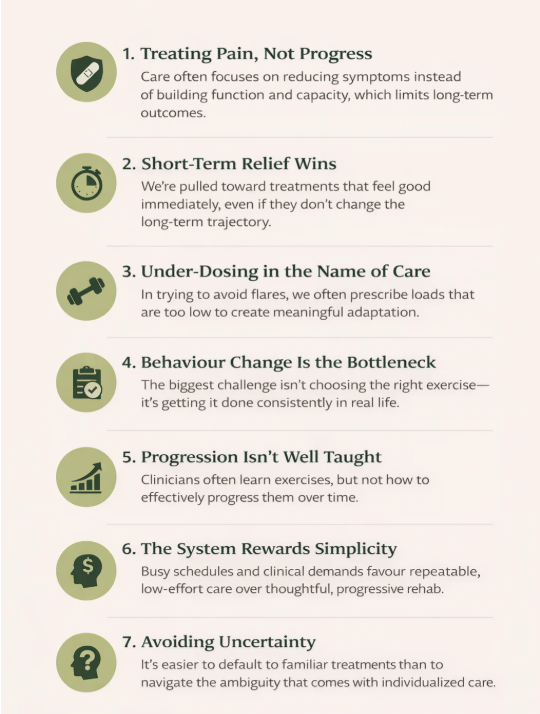
This case isn’t rare. And it’s not about calling anyone out. But it’s not good for the patient, the profession, or the trust our medical colleagues place in our expertise.
"I guess you could try physio" some physicians say to their patient's.
Evidence suggests an inverse relationship between years in practice and quality of care. We have to recognize how easy it is, for all of us, to drift, and the many forces that can pull care away from clinical practice guidelines.
The gap isn’t between good clinicians and bad clinicians.
It’s between:
- Knowledge and application
- Intention and execution
- A commitment to lifelong learning
Because the evidence will continue to evolve and we need to evolve with it. Our habits can’t be left to settle. If they do, what once worked well can and will become outdated.
Lifelong learning is more than courses or CE credits.
It’s:
- Setting goals and a plan for your growth
- Looking at your outcomes
- Questioning your defaults and biases
- Having conversations and staying engaged
- Reading research and listening to podcasts
- Updating what you do when the evidence asks you to
- Being willing to change, even when it’s uncomfortable
Not occasionally. Continuously.
Stay nerdy,