A few things happening behind the scenes at AMP
There’s been a lot going on that I haven’t had a chance to share. A few updates I’m excited about:
Sharing
Brainstorm: Many Pieces, One Recovery for anyone in our community who wants to go deep on concussion with an interdisciplinary panel for a day. Really thoughtful speakers here! More to come on this.
AOTA continuing education credits
AMP is now an American Occupational Therapy Association (AOTA) Approved Provider, with AOTA CEUs available for four courses:
There was a ton of work behind the scenes to make this happen. Thank you to everyone involved, particularly Lara Desrosiers, OT, for all the time and care she’s put into this.
AI in physiotherapy
I’ve been part of an AI working group with UBC’s Faculty of Medicine and the Physiotherapy Association of BC, looking at how physiotherapists in BC are using AI.
I’ll be sharing some of the survey findings with you soon, including what people are using, where they see value, and what concerns they have.
Dry needling courses, now available online
The online components of our two dry needling courses are now available without the live workshops:
Work through the anatomy, technique demonstrations, safety and clinical integration in your own time. Choose either course individually, or bundle both and save.
Now onwards to today's blog.
In an era of AI and endless summaries, yes, I still read research articles. The Royal Society’s motto, “Nullius in verba,” means “take nobody’s word for it.” I like that. I want to go to the source, see what people were actually asked to do, and work out what the findings mean for my messy world of clinical practice.
But it’s tough to give a paper 25 minutes and finish wondering how any of it helps the people I see later today. We want to be evidence informed, and our reading time needs to count.
One recent paper reminded me why a promising abstract gets me interested, but the methods decide whether I keep reading.
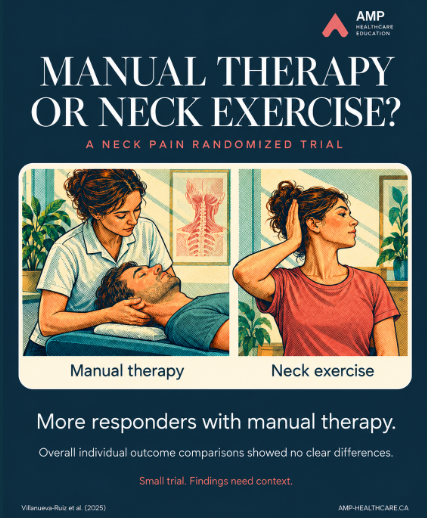
The abstract of a 2025 neck pain trial pulled me in: manual therapy produced more responders than exercise, but that difference dissolved among highly adherent exercisers. I have heard this story before. Interesting. Tell me more.
Next, I jump to the methods.
Sixty-five adults. People with radicular pain, previous whiplash and certain widespread pain features were excluded. Both groups had four weekly, 30-minute appointments with the same experienced physio.
Hands-on treatment included suboccipital techniques, intermittent traction and neck/upper-back mobilizations. The exercise program contained 13 exercises, individually prescribed and progressed, with roughly 20 minutes of daily home practice and video support.
Now I start questioning how much this would help me. Does this population resemble my caseload? Would I advise my patients to agree on that plan? Could I see myself doing this plan?
Don’t abstract surf. Go to the bloody methods section.
A program containing 13 exercises, with 20 minutes of daily practice? If someone did all 13, that’s about 90 seconds each, including changing positions. The prescription was individualized, so we shouldn’t assume everyone did the whole program. Still, I want to know what a typical home session actually looked like.
I hesitate to give someone more than three exercises when their main goal is pain reduction. Before adding more, I want to know what each one contributes and whether the plan fits their life.
The analysis gave me pause, too. “Responders” needed meaningful improvement in at least two of three areas: pain, disability and their overall impression of improvement.
The claim of equal effectiveness came from comparing manual therapy with just 18 exercisers reporting at least 95% adherence in a diary. Selecting that group after randomization weakens the comparison. People who improve might find it easier to keep exercising, too.
And finding no significant difference in a small subgroup doesn’t establish equivalence.
So here is how it played out in my mind. The abstract made me curious. The methods didn't seem grounded in reality. I stopped reading.
Before giving your next paper half an hour, spend five minutes checking:
- Who’s in it? Who was excluded, and does that matter for your patients?
- What happened? Could you deliver the treatment, and could someone realistically fit it into their life?
- Compared with what? Did the other group receive a credible treatment with reasonable support?
- What counted as success? Was it meaningful to patients, and measured long enough afterwards?
Then decide whether the paper deserves more time. You can put it down.
Notice what changes. A detail that makes me lose interest might make the study particularly relevant to your caseload.
I want research to challenge how I practise. But “this treatment works” leaves questions. For whom, at what dose, and with how much support?
“Take nobody’s word for it” includes the authors, the AI summary and me. Check what was actually done before deciding what to take into clinic.