
Jul 3 • Sean Overin
Psychedelics and Pain, One Year On 🍄
Empty space, drag to resize
There are a few tools that may have therapeutic potential to help those in pain I like to keep a gentle pulse on. Peptides (more on this soon), GLP-1s, and psychedelics to name a few. This week I went a reviewed psychedelics to see what has changed in the last year.
A year ago, I wrote about psychedelics, pain, and the idea of getting "unstuck." If you missed it, check it out here. It was early days then, and I said as much. A year later, I asked this question again: did anything actually move in the world of psychedelics for pain?
My answer: the field grew up a little bit. Some signals a bit stronger, one a bit weaker, and a useful shift that might have nothing to do with the drugs at all.

Here is roughly where the last twelve months landed based on what I dug up.
The condition-specific signals held up or improved.
- A UCSD phase I trial in phantom limb pain reported meaningful reductions in phantom and residual limb pain.
- Cluster headache, long the most compelling story here, got a randomized psilocybin trial: the headline result was non-significant, but a blinded extension phase showed reduced attack frequency, and the effect tracked with changes in hypothalamic connectivity.
- The fibromyalgia pilot I mentioned last year made it through peer review, still tiny, still open-label, but safe and seems directionally positive.
A corrective.
- The cleanest randomized, placebo-controlled trial of the year tested LSD microdosing for pain and found nothing. Fifteen micrograms across four sessions, no analgesic effect on experimental pain.
- A subgroup hinted at benefit after digging, and the dose may have been too low, but a negative result is the kind of thing the hype cycle tends to skip past.
Underneath the trials, the plumbing improved.
- There are now solid 2025 mechanism reviews mapping how classic psychedelics might act on descending pain modulation, neuroinflammation, and 5-HT2A neuroplasticity, so the "why would this even work" question has real answers now.
- And more money is in this space: the NIH put 21 million dollars behind the INSPIRE Network, the first federally funded program studying psychedelics in adults over 65, with chronic pain trials in its second phase (psilocybin for low back pain and LSD for cancer-related bone pain). That moves this out of scrappy pilot territory.
The thread that stuck with me most, though, was a survey. Nearly 300 orthopaedic pain patients were asked about psilocybin. A quarter had already tried a psychedelic. Only 3% had ever mentioned it to a healthcare provider.
Finally, I have my own anecdotal evidence.
I have been working with a veteran transitioning back to civilian life, carrying both PTSD and chronic low back pain, slowly building his exercise program back up. Part way through our work together he had the first of three ketamine sessions. He described an immediate drop in mental noise, his back pain fell from a 6 to a 1 out of 10, and his capacity for exercise opened up. Four weeks on, it had held.
Ketamine is not a classic psychedelic. It works through NMDA receptor antagonism rather than 5-HT2A, and it sits on much firmer clinical ground than psilocybin or LSD, with an established role in refractory and perioperative pain and a growing one in treatment-resistant depression and PTSD. So a response like his, while still an n of one, is not coming out of nowhere. It is exactly this kind of case that keeps me curious.

A year on, the picture still quite uncertain.
The signal is seems real but narrow with those hard to treat pain problems. The strongest in neuropathic and nociplastic states like fibromyalgia, phantom limb pain, and cluster headache.
Almost everything is positive for high-dose psychedelics, but these are small, open-label, or uncontrolled trials. The one well-controlled trial this year with LSD microdosing was negative.
The mechanisms seem more plausible and the research infrastructure is finally catching up, so the next two to three years should give us actual controlled data.
At the same time, the politics is moving faster than the science. In April, the Trump administration signed an executive order directing the FDA to fast-track psychedelics, and RFK Jr. has made expanding access, especially for veterans, an explicit priority. That is worth watching with both interest and caution, because regulatory speed running ahead of the evidence is exactly when proportioning our belief to that evidence matters most.
For us in clinic, nothing has changed about what we can offer. What has changed is that some of our patients are clearly already curious, and may be navigating it without us.
This one is reflective rather than hands-on.
Pick a single high-quality trial and read it properly, methods and all. A good choice is Schindler and colleagues' 2022 randomized, double-blind, placebo-controlled trial of psilocybin for cluster headache in Headache.
It is small and transparent about its limits, which is exactly what makes it useful: you can see how the research is actually built, how they randomized, what they used as a placebo, how they dosed by body weight in a pulse regimen, and how they handled a result that did not reach significance.
Then sit with two questions.
First, does the design actually support the claim being made, and what would it take to convince you. Reading a psychedelic trial the way you would read any other trial is the real skill here.
Second, where do you find the biological plausibility. Ask how one intervention might plausibly reduce pain and increase cognitive flexibility at the same time, and whether those two things are as separate as they look.
That overlap, between turning down a pain signal and loosening a rigid pattern, is the thread worth pulling. [head.14420]

A few options, depending on your appetite.
For the clinical lay of the land, read the 2026 review in Drugs, Classic Psychedelics for Chronic Pain: A Critical Review of the Literature and Practical Advice for Clinicians. It is measured, points out the weak spots plainly, and is written for people who see patients.
If you want the biology of why descending modulation and neuroplasticity keep coming up, pair it with the 2025 mechanism review in ACS Chemical Neuroscience.
If you would rather listen, Sam Harris recently sat down with Robin Carhart-Harris on the Making Sense podcast, "The Psychedelic Mind". Carhart-Harris is the researcher behind the REBUS and canalization models I leaned on last year, and the conversation is a tour of where the field actually sits: set and setting, the default mode network, macrodosing, microdosing, and the recent regulatory setbacks included.
And if a patient is going to explore this with or without you, point them to www.entheo.org. A few colleagues and I built this a few years ago. Groundd in harm reduction and experience optimization, it is a free resource that walks people through the full arc: a library of resources, how to prepare, how to do proper medical screening, and how to integrate the experience afterward. Knowing it exists lets you meet a curious patient with something useful rather than a flinch.

The psychedelic bubble has burst.
What is left once the hype drains out is research growing up, and a few signals that keep holding: REBUS, descending pain modulation, and the link between flexibility of mind and flexibility of pain.
Hume put the posture well: "A wise man proportions his belief to the evidence." But here is what I cannot let go of.
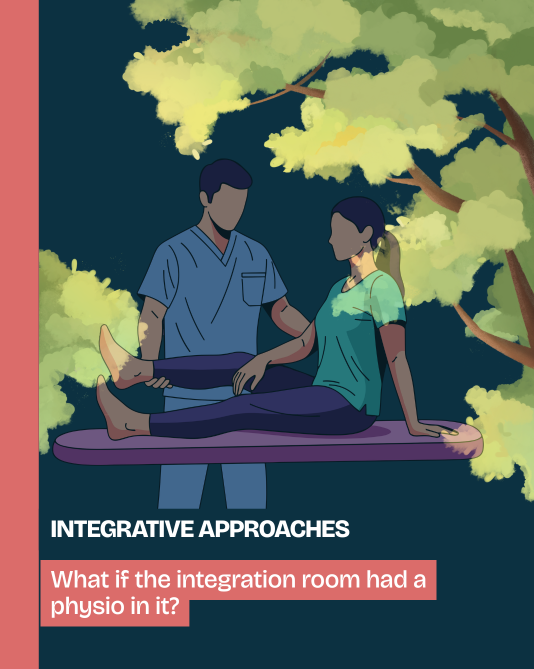
Every one of these pain trials pairs the drug with psychedelic-assisted psychotherapy, almost always delivered by psychologists. What if we paired it instead with the things we already know move persistent pain: clear pain education, graded activity, specific exercise, and lifestyle change? I would bet the signal gets stronger. And if that is true, the clinician in that integration session might not be a psychologist at all. It might be a physio.
Closing reflection
So let's keep revisiting these emerging spaces. Read the trials, watch the signals, and hold the exciting parts loosely. But let's not lose the plot while we do it. We already know where the bread and butter of good pain care lives: in trust, education, movement, graded exposure, and the slow work of helping someone feel safe and capable in their body again. Whatever psychedelics turn out to be, they will only ever be a door. What happens in the room afterward is still our work, and that part we are already good at.
Stay nerdy,
Sean
Sean Overin, PT
Subscribe to our newsletter
Every Friday we cover must read studies, how they fit in practice, give it real world context, provide top resources and one sticky idea.
Thank you!
You have successfully joined our Friday 5 Newsletter subscriber list.