Empty space, drag to resize
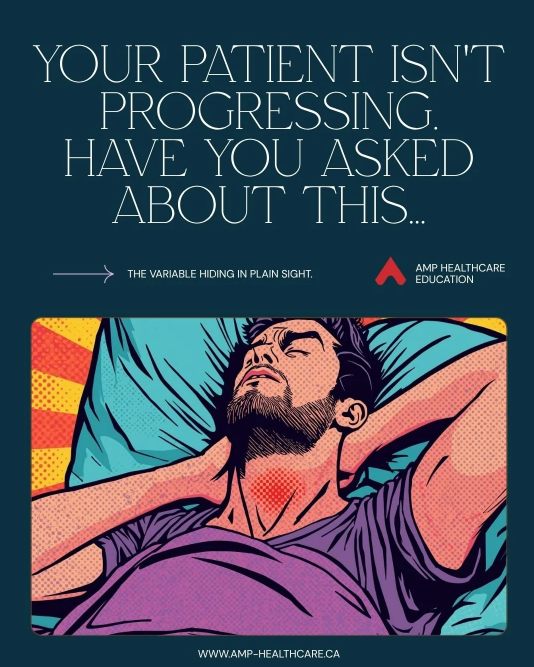
A patient comes in once per week for 6 weeks with new neck pain that isn't moving the way it should. You've adjusted the program, tried different approaches, gone through their daily habits. Then, almost as an aside, they mention they haven't been sleeping well in months. It's easy to file that away and move on. It probably shouldn't be.

A
2024 systematic review with meta-analysis published in PAIN examined the bidirectional relationship between sleep problems and chronic musculoskeletal pain across a large body of longitudinal studies.
The direction of effect was consistent in both ways: poor sleep predicted worsening pain, and persistent pain predicted worsening sleep.
A
2025 clinical guide in JOSPT Open ("The Pain of Poor Sleep: A Clinician's Guide to Assessing and Addressing Sleep Dysfunction in People with Musculoskeletal Pain Conditions") builds on this to offer something more immediately useful: a practical framework for rehab clinicians to screen for and address sleep dysfunction within the scope of practice.
What the evidence keeps showing is that sleep is not simply a symptom of chronic pain - it's one of its active drivers. Poor sleep reduces pain thresholds, amplifies central sensitization, and increases inflammatory signalling. It erodes the emotional regulation that helps people tolerate uncomfortable movement, difficult messages, or rehab.
And it feeds a cycle: more pain, less sleep; less sleep, more pain.
The prevalence is worth sitting with for a sec. Somewhere between 50 and 70 percent of people living with chronic pain have clinically significant sleep disturbances. That means it's almost certainly present in a meaningful proportion of a typical caseload. But in most rehab settings, sleep goes unassessed.
There's also an important reframe here for how we understand treatment response. When a patient isn't progressing, we tend to look at technique, load, frequency, adherence, or psychosocial factors. Sleep rarely makes that list. Yet if someone is in a state of chronic sleep deprivation, their capacity to adapt, regulate, and benefit from even a well-designed program is compromised from the start. We might be fine-tuning the details while missing something more foundational.

Sleep and musculoskeletal pain modulate each other through neurological, inflammatory, and psychological pathways. Poor sleep lowers pain thresholds, impairs emotional regulation, and upregulates central sensitization. Pain disrupts sleep architecture and reduces restorative deep sleep. This cycle is self-reinforcing, and it often runs in the background of a caseload.
Rehab clinicians are well-positioned to screen for sleep dysfunction as a routine part of assessment.
Validated tools exist and take minutes:
- Insomnia Severity Index
- STOP-Bang for obstructive sleep apnea risk, and
- a few direct questions about quality and duration can reveal a lot.
Within scope, clinicians can offer basic sleep education, help patients understand the sleep-pain connection as part of broader pain neuroscience education, and refer to sleep medicine when the picture warrants it.
The practical point: if a patient isn't progressing the way the program suggests they should, asking about sleep or other stressors is a good next step.
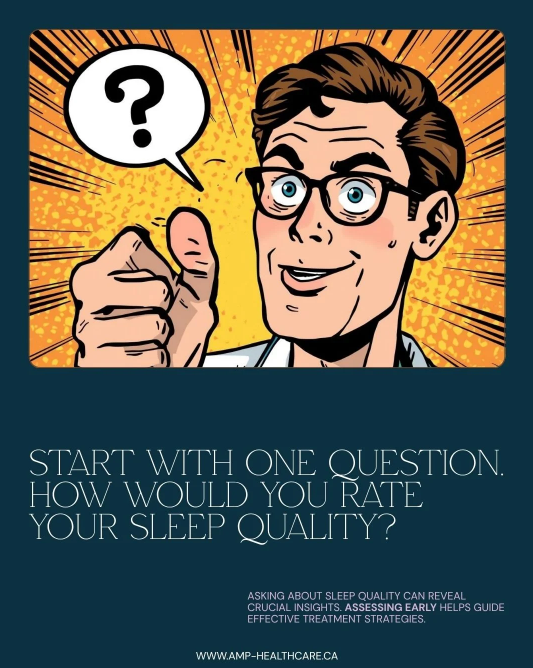
Start by adding one question to your intake form:
"How would you rate the quality of your sleep? (Poor / Moderate / Good)."
That single item does something useful - it signals that sleep is part of what you pay attention to, and it gives you a natural reason to bring it up without it feeling like a detour.
From there, a few clinical patterns are worth flagging for yourself.
- Is this person reporting three or more pain sites? Think sleep.
- Are they always tired, low energy, low mood? Think sleep.
- Are they not responding the way you'd expect despite solid first-line care? Think sleep.
At the initial assessment, you don't need to go deep - just lay a frame.
Something like:
"Sleep, pain, and mood often travel together, and it's worth keeping an eye on. We'll get started with treatment and see how things go. But if in six to eight weeks we're not seeing the progress, would you be open to me bringing that up again? We might want to look at it more closely then."
Most patients will say yes. And now you've created an honest opening for a sleep conversation if you need it later, without front-loading the visit with questions that feel off-topic when someone just wants help with their shoulder.

1. Read: "
The Pain of Poor Sleep: A Clinician's Guide to Assessing and Addressing Sleep Dysfunction in People With Musculoskeletal Pain Conditions," published in JOSPT Open (2025).
It offers a stepped clinical framework - from basic screening questions to validated tools to referral pathways. It is pragmatic, within scope, and fills a gap that most rehab training doesn't address.
2. Pair it with the 2024 meta-analysis on the bidirectional sleep-pain relationship in PAIN for the mechanistic context that makes the clinical approach make sense.
3. If you want to go deeper and actually use CBT-I with patients, we cover it in our course:
amp-healthcare.ca/course/cbti. CBT-I is the gold standard for chronic insomnia and one of the more transferable skills a rehab clinician can pick up - it works, it's within scope, and your patients will likely need it more than you'd expect.

Sleep is a key modulator of pain and one of the least assessed variables in rehab practice. We spend careful attention calibrating load, refining technique, and building therapeutic alliance. It seems worth spending two minutes asking about the thing that may be setting the ceiling on all of it.
We're good at addressing the things we can see and measure in session. Sleep happens somewhere else, outside our clinical view, which may be partly why it's easy to deprioritize. It is also something patient's don't expect to discuss or work on when they are coming in with a pain complaint.
But the evidence is clear enough now that leaving it unasked is a missed opportunity and a gap in the assessment.
The question then becomes: can we make room for it?
I think we know the answer to this.
Stay nerdy,