Empty space, drag to resize
A man in his early fifties came in wanting one thing: to keep an erection throughout intercourse. He could get one, he just could not maintain it for penetration. When I first met him his history read like a cardiology intake. Type 2 diabetes, hypertension, a heart attack at fifty, and somewhere north of thirty beers a week.
My first instinct was to reach for a label. Is this vasculogenic or neurogenic? Maybe because I am new at this stuff. But I sat with that question longer because the more I looked at him, the less the label seemed to be the point, which is often the case if I draw from my experience in MSK pain.

First, a quick primer, because most of us outside urology never learned this.
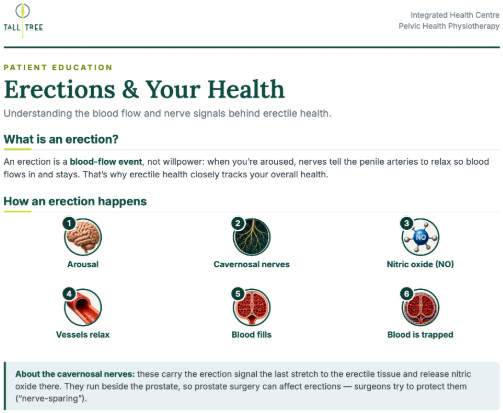
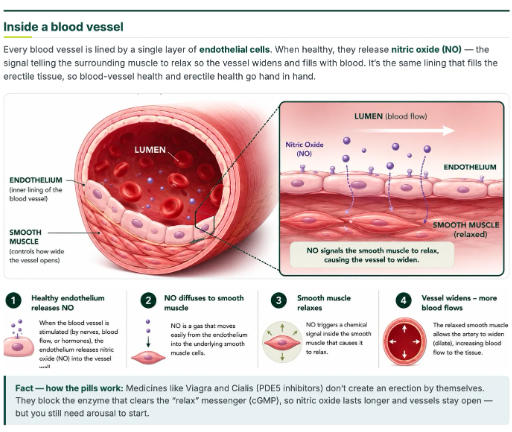
- An erection is a blood-flow event. Arousal signals run down the cavernosal nerves, which sit right beside the prostate, and release nitric oxide into the erectile tissue. Nitric oxide tells the smooth muscle lining the penile arteries to relax, the vessels widen, blood floods in, and the outflow veins get compressed so it stays.
- Two small pelvic floor muscles, the ischiocavernosus and the bulbospongiosus, then clamp at the base to raise the pressure and hold it firm. Nerves start it, arteries fill it, muscles keep it going.
- Break any link in that chain and the erection changes.
It also helps to know there are three kinds.
- Psychogenic erections start in the mind, from thought or desire.
- Reflexogenic ones come from direct touch, a spinal reflex that can persist even when the psychogenic route is disrupted.
- Nocturnal erections happen automatically in sleep and keep the tissue healthy. This one is an important diagnostic gift. Still waking with erections? The hardware mostly works, which points away from a purely vascular or neurogenic cause and toward something psychogenic or situational.
With that map in hand, we sort ED into boxes: vasculogenic, neurogenic, endocrine, drug-related, psychogenic, or mixed. A useful scaffold. The problem is that this patient has the ingredients for almost all of them at once.
Vasculogenic is the common denominator here, and it is worth understanding why. The penile arteries are small, roughly one to two millimetres, so they stiffen and narrow before the larger coronary vessels do. That is why erectile difficulty so often arrives years before a cardiac event, and why
ED is now treated as an independent predictor of cardiovascular disease rather than a quality-of-life footnote. In this man the sequence is almost textbook, except his heart attack already announced the disease the ED was quietly flagging.
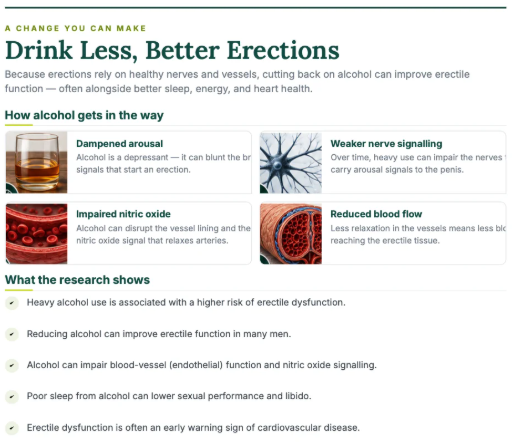
But it is not purely a plumbing story. Diabetes drives an autonomic neuropathy that degrades the cavernosal nerve signal and the nitric oxide release that actually starts the erection. Heavy alcohol works both ends, blunting the endothelial lining and dampening the nerve signalling on top of it. So the read here is not vasculogenic versus neurogenic. It is mixed, vascular-predominant, with a neurogenic layer, sitting on a lifestyle that keeps feeding both.
The one detail that does earn its keep is his chief complaint. He can attain but cannot maintain. Maintenance is a veno-occlusive job, trapping blood under pressure, and that leans the picture toward a vascular and muscular mechanism rather than a pure failure to initiate. That is a clinically useful distinction, and it points somewhere we can actually work.
And the more I sat with it, the more that somewhere had less to do with nailing the label than with what he does between our sessions, which is where I want to go next.

Here is what I keep coming back to, and it is not really about erections at all.
The work with this patient, like so many, is behaviour change, and that lives or dies on communication, not on the exercises we work together on.
If you have treated persistent low back pain, a cranky knee, or a stubborn tendon, you already know this work. Yes, he has specific pelvic floor exercises to train the muscles that hold an erection, but those sit inside a bigger plan of lifestyle change, moving more, drinking less, managing his numbers, exactly the way load, sleep, and activity sit around an MSK plan.
So the session looks less like prescribing and more like motivational interviewing, eliciting perspectives, goals he actually chose, a
personal action plan, a measure of his confidence, and regular follow-ups that keep it honest.
The hard truth is that the outcome he and his partner want most, a reliable erection for intercourse, is not here yet, the same way a pain patient's return to normal often stays just out of reach for a while. I hope it happens for them, but I cannot promise it, so we can't make it the only part of the scoreboard.
Instead, in the current moment, we celebrate the small wins, the walk he did not skip, the week he drank less, the gym session he showed up for, because those compound, just as they do when someone fearful of movement gets back under a barbell.
When something slips, and it will, we troubleshoot it together. Whether the complaint is an erection or a spine, progress is measured in habits that stick and momentum reflected back, not in a single perfect outcome.
Pick one patient this week who needs a lifestyle change, whether it is ED, back pain, or anything else, and notice + resist the urge to tell them what to do.
Try one motivational interviewing move instead: the scaling question.
Ask, on a scale of zero to ten, how important is this change to you, and then, how confident are you that you could make it happen.
The magic is in the follow-up.
When they answer, say a five or six, ask why they did not pick a lower number. That single question makes them argue for change in their own words rather than yours, which is the whole point.
Notice how different the room feels when the reasons come from them.
Then reflect their own words back, and agree on one small, specific step they choose, not one you assign. It takes about two minutes, and it beats another round of advice nobody asked for.
Live + In-person
Mobs, manips, clinical reasoning and so much more.
24/10/2026 - 25/10/2026
Start Line Health, Duncan, BC
If you want the evidence first,
Martin and colleagues (Musculoskeletal Care, 2019) meta-analysed behavioural counselling, motivational interviewing included, in adults with chronic painful musculoskeletal conditions and found a small increase in physical activity and a moderate improvement in self-efficacy, the belief that you can actually do the thing.
Self-efficacy looks like a real step on the path to lasting change, which means part of our job is building confidence, not just handing over knowledge. The effects were modest, so treat it as a nudge rather than a magic bullet, which is rather the point.
If you want to go deeper, we built two AMP courses:

Many healthcare providers are trained as mechanics and then asked to work as coaches.
The mechanic finds the broken part and fixes it.
The coach helps a person do hard things over and over, in a life full of reasons not to.
I have been reading Walter Isaacson's
biography of Leonardo da Vinci, arguably history's greatest mechanic of the body, who dissected cadavers to map every muscle and valve in the mid to late 1400's. Yet he almost never called a work finished. As Isaacson puts it, even late in life he was "still Leonardo, always pursuing a curiosity, less passionate about tying up loose ends," carrying the Mona Lisa for years, still adding layers, treating it as something to return to rather than a job to close out.
Much of what walks through our doors is chronic, managed rather than fixed, and it rewards that same patience. The value is in the returning, not the finishing.
My patient still does not have the outcome he came in for. I hope it arrives, and I am truly uncertain if it will. But he is doing the unglamorous work that actually moves the needle. Whether or not that particular win lands, the lesson holds. The most valuable thing I can offer him is not my knowledge of vessels or nerves or muscles. It is helping him find ways to keep going. That is true for him, and it is true for almost everyone who walks through the door.